The first ego machine in Britain appeared at the Blackpool Institute of Technology's Lost Inventions and Fantastic Creations exhibition in 1860. A Parisian group from the Université Paris 1 Panthéon-Sorbonne assembled a working mechanism and displayed it alongside printed articles and lithographic illustrations.
Exhibition Catalogue Entry
Blackpool Institute of Technology, August 1860
A mind mechanism or a golem for our times.
The Université Paris 1 Panthéon-Sorbonne presents, for your entertainment and intellectual edification, a mechanism simulating consciousness, based on the famous Tlön, Uqbar, Orbis Tertius manuscript and assembled with care from contemporary materials.
We will give a talk detailing the history and operation of the mechanism twice daily. A pamphlet which provides translated annotations and lithographs copied faithfully from the original manuscript is available for your inspection.
Consciousness
The mechanism transcribes sight and sound onto the spinning disc, whose spinning serves also to stabilise and propel. It conveys impressions received by the main funnel and via vibrations to a needle that engraves the disc surface. It transmits the recorded sound impressions to the Consciousness Sphere via the vibrational energy experienced by another needle. A single lens attached to the Sphere reads visual impressions from the disc surface.
The mechanism function therefore posits that Human Consciousness is nothing more than Awareness. Specifically, awareness of the recorded contents on the disc surface or what we may now interpret as the mind or ego.
Madness and Suffering
The disc spins and the ocular mechanism and auditory needle are, mostly, fixed onto the surface of the disc, though both the ocular mechanism and needle, despite the operation of damping mechanisms, jump randomly between grooves on the disc surface. The Consciousness Sphere is therefore subject to a continuous stream of semi-random impressions, impressions which become more salient in delirium and madness though even temperate dispositions experience wayward thoughts numbering in the hundreds every moment.
Death and Sleep
The disc stops spinning in darkness. Spinning starts when the light returns. Sometimes the spinning cannot start. This coincides with critical damage to the mechanism, whether by age or trauma. Sleep and death, in terms of awareness or consciousness, are therefore identical.
Enlightenment
There is flexibility inherent in the ocular mechanism attached to the Consciousness Sphere which allows the lens to see over the edge of the disc. Peering over the ego disc rim corresponds to the Christ-like awareness achieved only in advanced meditative states. The flexing of the ocular mechanism is difficult and effortful. Some can see the abyss beyond the rim, if only for a moment. Contemplation of the serene darkness changes them forever.
Most achieve only a twitching of the ocular mechanism and condemn themselves to live through the ego until their disc ceases to spin and their breath stops.
Exhibition Materials
The following illustrations are facsimiles taken from the Anglo-American Cyclopaedia. An illustrator, commissioned to make lithographic prints for the exhibition, reportedly used the original manuscript.

Figure 1. Page from the Tlön, Uqbar, Orbis Tertius manuscript showing early flying machine concepts and mechanical studies. (Lithographic reproduction)

Figure 2. Manuscript page depicting an ornithopter design, fetal studies, and spherical mechanisms. (Lithographic reproduction)

Figure 3. Sketch of the mechanism by the Blackpool Evening Gazette journalist, 1860.
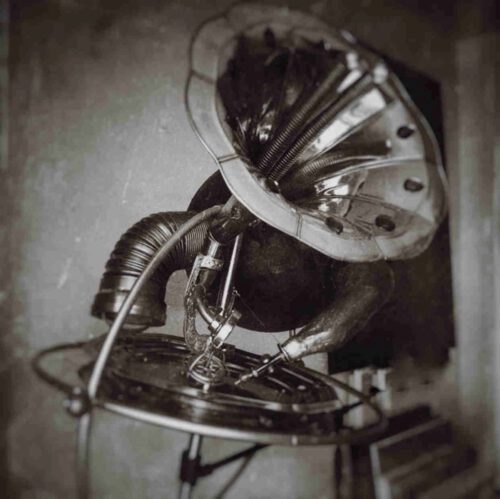
Figure 4. The Dorian mechanism (1886), photographed at the Royal Institute, London.
Contemporary Accounts
"The mechanism moved and spoke with great intelligence and animation."
— Blackpool Evening Gazette, August 1860
"The mechanism appeared in the 1862 International Exhibition in London, its listing was absent from the exhibition catalogue second print run. The organisers gave no reason for the removal."
— Exhibition records, 1862
"The mechanism [was] broken, or it had never worked."
— Kensington and Chelsea Times, 1862
Aftermath
The Parisian exhibit stimulated interest in the ego machine, for construction of Dorian, the Royal Institute's ego machine, began a month later.
Dorian was assembled by the Royal Institute in London in about 1886. It made several public appearances and was, according to contemporary eye witness accounts, able to generate poetry on demand. The reporter noted that the poetry was of a melancholy vein though, if prompted, Dorian would also recite vulgar limericks. Dorian was retired three years later.